0:00
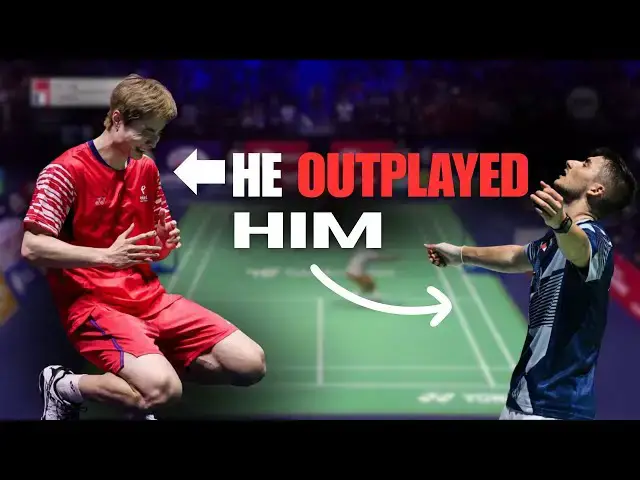
In this video, we want to take a deeper
0:01
dive into how Shuyuchi of China was able
0:04
to clinch out the match against the home
0:06
crowd favorite Christo Popoff.
0:10
We will focus on how Shiuchi adapted his
0:12
gameplay in response to common shot
0:14
patterns played by Kristo as well as how
0:17
Christo made the game extremely close.
0:25
In almost all of his matches, Shuyuchi
0:28
would lose the first set but end up
0:30
winning the match in the end. The reason
0:32
he is ultimately able to win the matches
0:34
in the end is because of his ability to
0:37
read his opponents and hence make subtle
0:39
changes that will allow him to gain the
0:41
edge in rallies. If we take this game
0:43
for example, Shuuchi the player in red
0:46
noticed a common pattern in Christo's
0:48
game. the player in white specifically
0:51
after Kristo half smashed from his
0:53
around the head side. After Kristo would
0:55
hit this shot, Shiuchi would take the
0:58
extra effort block middle to Christo's
1:00
left side of his body outlined here on
1:04
Even though the straight block would be
1:05
the easiest shot to execute in this
1:07
situation, Shiuchi would block middle.
1:13
because this block to the middle would
1:15
force Kristo to take his forehand.
1:18
From this position, there aren't many
1:20
shot options that Kristo has, and he
1:22
would almost always play the straight
1:24
net. Shiuchi would anticipate this and
1:27
move preemptively in anticipation of
1:34
And he knew this under the premise of
1:38
First and foremost, winning the net is
1:41
the key to winning the rally. When you
1:43
control the net, you are in control of
1:45
the rally, especially in men's singles.
1:48
Knowing this, Shiuchi can make a guess
1:51
as to where Kristo will play his shot.
1:53
So, by figuring out his opponent's game
1:55
plan and his opponent's mentality,
1:57
Shiuchi can make the assumption as to
1:59
what shot Christo is going to play. In
2:00
this case, it'll be the net, as these
2:03
players really don't want to give away
2:05
the lift, especially toward the later
2:13
The second consideration is the angle
2:15
and momentum Crystal has when he comes
2:17
into play this shot. First, let's talk
2:19
about momentum. After playing a half
2:20
smash, it's in your best interest to try
2:23
to take the net as early as possible to
2:25
change the pace. This is how you get the
2:27
opportunity to attack. So, after Cristo
2:30
hits his half smash, his momentum is
2:34
If he chooses to push, it's extremely
2:36
easy to push it out the back, especially
2:39
with drifty conditions, and thus the net
2:42
is often safer. Second, the angle. How
2:46
did Shiuchi know that Kristo would net
2:48
straight instead of hitting to the other
2:50
side of the court? This is simply
2:52
because of the angle that Christo is
2:53
coming to take the shot. The angle that
2:55
Kristo is coming from makes it extremely
2:58
difficult for him to play to the other
3:00
side of the court that she has left
3:01
open. To play across to this position on
3:04
the screen, Kristo would have to adjust
3:06
his racket and open his racket face to
3:12
This requires extra skill and thinking
3:14
that players often aren't necessarily
3:16
thinking about in the heat of the
3:18
moment. So when Shiuchi blocks to the
3:22
middle after Kristo plays an around the
3:25
head half smash straight, he does this
3:28
to force Kristo into using his forehand
3:30
grip, which consequently forces him to
3:34
play this side of Shiuchi's court. From
3:37
here, Shuuchi can cover the most
3:39
dangerous shot, the spin net from
3:41
Kristo, which is often why he moves up
3:44
before Kristo has even contacted the
3:48
If Christo does choose to lift, he lifts
3:50
to Shiuchi's around the head, arguably
3:53
his best side for attack.
3:59
Another example of Shiuchi reading
4:01
Christo's habits is on Christo's
4:02
backhand side of the net. A common shot
4:04
that many players, not just Christo,
4:06
tend to play is the cross push from this
4:10
And these rallies are excellent examples
4:11
of how Shiuchi was anticipating the
4:23
Shiuchi is someone who has plenty of
4:25
experience and knowledge, and these
4:27
adaptations ultimately allowed him to
4:29
win. Of course, that doesn't make
4:31
Shiuchi the perfect player, though. So,
4:33
let's take a look at what made this game
4:38
When we watched the rallies between
4:40
these two players, most of the time it
4:42
was Shiuchi who was controlling the pace
4:44
of the game. He would control the rally
4:46
so well only to make an unforced error
4:49
at the end. For example, take a look at
4:52
this rally where Shiuchi controlled very
5:01
In a tournament as big as the World
5:03
Championships, it's inevitable that a
5:05
few unforced errors would be made due to
5:07
the pressure. And ultimately,
5:11
many matches are won by those who are
5:12
more consistent and can handle the
5:15
pressure. And that's exactly what Kristo
5:20
Kristo was very good at staying in the
5:21
rallies, making it very difficult for
5:23
Shiuchi to score. The more shots that
5:26
Crystal returns, the more impatient she
5:28
becomes, thus the more errors she makes.
5:33
However, how can us, the audience, learn
5:36
from these unforced errors? The first
5:39
thing to learn from this match is
5:42
What we mean by this is being able to
5:44
make the points difficult for your
5:46
opponent to earn, not because you are
5:48
controlling them, but because you are
5:50
simply getting everything back.
5:53
When playingers that are similar to your
5:55
skill level, it isn't possible to always
5:57
control every single rally and every
5:59
single shot. There will definitely be
6:02
times when they get the edge and start
6:03
controlling you. But it's in these
6:05
rallies where you have to continue
6:08
retrieving and focusing on getting the
6:10
shuttle over the net.
6:16
How did he get that back?
6:25
The second lesson to learn is where
6:27
you're placing your shots.
6:29
Especially in a drifty hall where there
6:31
is often sideways drift, trying to aim
6:34
for the lines is extremely risky. That's
6:36
why many pro players will simply hit
6:38
their shot towards the middle or aim a
6:40
little further from the line. Because
6:42
when they try to pin the lines, this is
7:02
That is also why in this game the pace
7:05
was extremely fast because both players
7:08
were fighting for control of the net and
7:10
playing flat exchanges to minimize
7:15
if you ever find yourself playing in a
7:18
one tip would be to play safer and less
7:20
risky shots to try to get a feeling for
7:23
the court conditions first before trying
7:26
to play more towards the lines. And as
7:29
you play your matches, staying
7:31
coolheaded and paying attention to your
7:33
opponent's common tendencies can help
7:35
you gain control of rallies more often
7:38
and increase your chances of winning.
7:41
If you like this video, make sure to hit
7:43
the like and subscribe button as it
7:46
helps out the channel a lot. And as
7:49
always, thanks for watching.