0:00
Hi everyone, welcome back to the
0:02
channel. Today we're going to shift away
0:04
from men's singles a little bit and take
0:06
a look at the women's singles finals at
0:08
the 2025 Yonx Taipei Open between
0:11
Japan's Tamoka Miyazaki and Thailand's
0:13
Pichimon Opatnapoth who we'll refer to
0:16
as pink. We wanted to highlight this
0:18
match because it is an excellent
0:19
demonstration and contrast on why having
0:22
strong legs is important in bad mitten.
0:24
From our view, Tamoka Miyazaki
0:26
ultimately won this match due to her
0:27
physicality. By being able to stay low
0:29
to the ground, Miyazaki was able to play
0:32
with much better body control and won
0:34
through taking the net very
0:35
early. The very same idea of having a
0:38
low center of gravity and good body
0:39
control is also why Pink lost. She had
0:42
good moments in the match where she did
0:44
exhibit these qualities and show how she
0:46
can be a deadly player with how good her
0:48
shots are, but her inability to
0:50
consistently stay low to the ground
0:51
definitely hindered her gameplay.
0:54
We may not be women's singles players
0:57
viewers, but being able to maintain a
0:59
low center of gravity is important
1:01
regardless of the badminton discipline
1:03
we play. And building strong legs is the
1:09
Oh, makes a save, but it is.
1:14
The first advantage that we want to
1:16
discuss about maintaining a low center
1:17
of gravity is that it allows you to take
1:19
shots higher at the net. I know it
1:23
counterintuitive. How does getting lower
1:25
allow one to hit the shuttle higher?
1:27
Well, the discussion is less about where
1:29
you're actually taking the shuttle, but
1:31
your racket position. In general, being
1:33
able to approach and hit the shuttle
1:35
with your racket head facing up is far
1:37
more deadly than having your racket head
1:39
face towards the side or down. The
1:41
reason is because the shuttle is
1:43
guaranteed to go upwards with a lower
1:45
racket setup, while a higher racket
1:47
setup allows you to play shots going
1:48
both downward and upward.
1:51
Thus, by leading with your racket in a
1:54
high position, you put infinitely more
1:56
pressure on your opponents than if you
1:59
lead with the racket in a lower
2:01
position. This is part of the reason why
2:03
Miyazaki shots often feel deceptive and
2:06
makes it extremely difficult for Pink to
2:08
move. Every time Miyazaki takes a higher
2:11
racket approach, she can threaten a
2:12
faster paced shot. Pink has to respect
2:15
this faster paced shot or she won't be
2:17
able to reach the shuttle in time which
2:19
makes the fast to slow pace change
2:20
effective. Here are some more examples
2:22
of how a higher racket approach helped
2:33
match again. Stunning drop
2:38
shot. Plays that really well again. It's
2:42
orney put it full stretch and
2:53
then now a reason getting low is so
2:57
important is because it increases your
3:00
opportunities to take the shuttle at the
3:02
net with a higher racket approach.
3:06
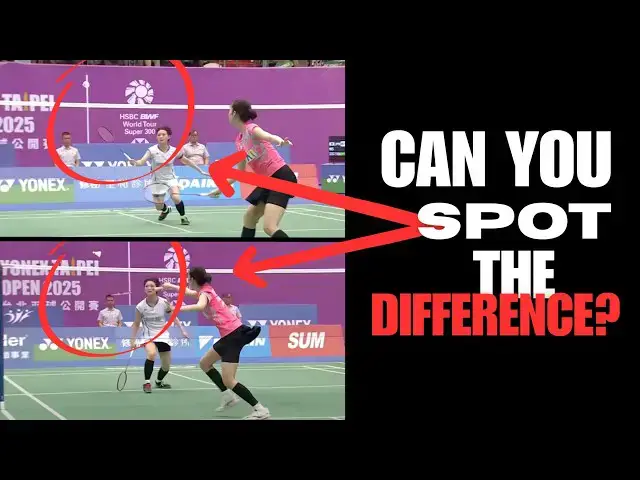
Compare these two images of Miyazaki in
3:07
pink and see their racket positions
3:10
relative to the shuttle. Both are taking
3:12
the shuttle at about the same height.
3:15
Yet Miyazaki has her racket head facing
3:17
upwards while Pink has her racket head
3:19
facing toward the side. Pink's best
3:21
shots are essentially a spin net or
3:23
push, while Miyazaki has numerous more
3:26
options like potential drives, brushes,
3:28
and a high cross net. Of course, at some
3:30
point there's no reason to get lower as
3:33
even if you're able to take the net with
3:35
a high racket approach, it won't matter
3:37
if the shuttle is well below the tape.
3:39
What does matter though is how you take
3:41
the shuttle when it's around the tape.
3:43
When the shuttle is at the tape, a high
3:45
racket approach will still allow you to
3:47
play shots like brushes and slice net
3:49
kills alongside high cross nets. With a
3:51
lower approach, however, you're limited
3:55
pushes. For pink, her ready position
3:58
limits her to take the shuttle with a
4:00
high racket approach only when the
4:03
shuttle is above the tape. Miyazaki,
4:06
however, can take the shuttle with a
4:09
approach, even when the shuttle is at
4:13
tape. On a side note, this is an
4:16
advantage that shorter players have over
4:18
taller players. Shorter players can gain
4:21
this high racket approach much more
4:23
often as it doesn't take as much
4:25
strength to get to a low enough position
4:26
that allows them to do so. Pink is tall
4:28
for a girl after all. Standing at 172 cm
4:33
tall compared to Miyazaki's 165 cm. And
4:37
you can see how leg strength isn't one
4:39
of her fortees compared to
4:42
Miyazaki with all the strapping she has
4:46
on. Because Pink's legs aren't
4:48
particularly strong, while Miyazaki's
4:50
legs are, the difference can be starkly
4:52
seen in the two players upper body
4:55
control, particularly on defense. When
4:58
you don't have strong and mobile legs,
5:00
you can often end up compensating for
5:02
the weakness by bending your upper body
5:05
lower. The problem with doing this,
5:08
however, is that it'll make your
5:09
footwork slower, as you'll need to take
5:11
time to return your body to its original
5:13
position. This can be extremely
5:15
detrimental as it's entirely possible
5:17
that your opponent is already playing
5:19
the next shot while you're still
5:20
recovering to the middle and is a big
5:22
reason why it constantly felt like Pink
5:24
was the one following Miyazaki's pace.
5:26
Another issue is that bending your upper
5:28
body adds another movement to your
5:30
defensive footwork that you normally
5:31
wouldn't have if your center of gravity
5:32
was already low. This is why you'll see
5:35
Pink struggling to defend against
5:36
Miyazaki's attacks. While Miyazaki
5:38
generally has a better time defending
5:40
against Pink's attack, it ultimately
5:42
boils down to Miyazaki being able to
5:43
hold the lower center of gravity much
5:46
better than Pink can. Coming out of the
6:17
This is already a much better start to
6:47
Regardless of whether you're a singles
6:48
or doubles player, being able to have
6:51
and maintain a lower center of gravity
6:53
is absolutely crucial. But
6:56
admittedly, getting lower is something
6:58
that pretty much all coaches will tell
7:00
you to do since you start playing bad
7:01
mitten. What is talked about less,
7:03
however, is how low should you actually
7:06
go? Because at some point, there's not
7:09
much of a point to bring your center of
7:11
gravity any lower than it is. You
7:12
wouldn't want to be moving around the
7:14
court in a deep squat. After all, to
7:16
understand how low you must go, you must
7:19
understand some of the reasons for why
7:21
having a lower center of gravity is
7:23
important. We already discussed two
7:25
reasons in what kind of racket approach
7:26
you're able to take at the net. when
7:29
shuttle is at the tape as well as how
7:31
you want to limit bending your torso
7:33
when on the defensive.
7:35
Thus, a good reference is to get low
7:38
enough to be able to hold your racket
7:41
with its head facing up at the tape and
7:44
low enough that your upper body is not
7:47
always dropping down when playing
7:48
defensive shots. And to expand on that
7:51
point, getting low should be done with
7:53
your legs and not so much your upper
7:56
body. Once you find a positioning that
7:58
works for you, then it's a matter of
8:00
practicing to move smoothly without your
8:04
center of gravity shifting and being
8:06
able to hold those positions to last the
8:09
entirety of your games and competitions.
8:14
If you like this video, don't forget to
8:16
hit the like and subscribe button so you
8:18
don't miss out on our future content.
8:20
Let us know what you would like to see
8:21
next in the comments below.