0:00
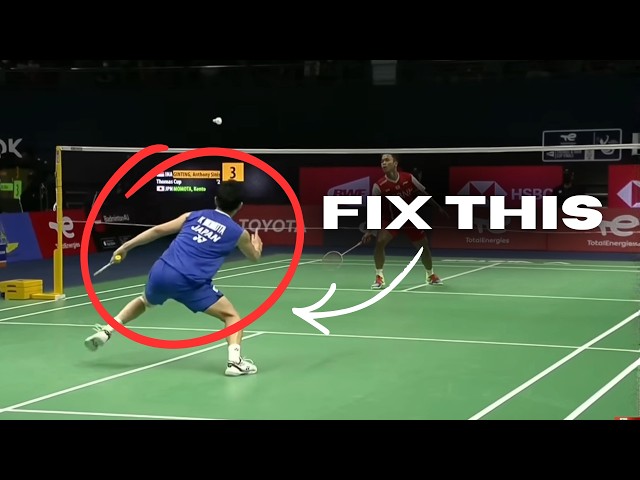
Getting caught by a deception may be one
0:01
of the worst feelings in badminton.
0:04
We've probably all experienced this at
0:05
least once in our lives where we're
0:07
stuck to the ground or worse on the
0:10
ground as our opponent play the most
0:14
If it happens once or twice in a match,
0:17
it's mostly just a slip up in focus. But
0:20
if it happens a lot, then you need to
0:30
>> One of the biggest reasons people get
0:31
caught by deceptions is because they
0:35
If you're already sprinting in
0:36
anticipation of the next shot and your
0:39
opponent suddenly switches their shot,
0:41
you're going to get stuck and struggle
0:43
to retrieve it. And one of the biggest
0:46
reasons people move too early is because
0:48
they're scared and feel like they're not
0:50
fast [music] enough to reach whichever
0:52
corner they're rushing to.
0:54
Now, it is often [music] the case that
0:56
this fear is warranted. You might not
0:58
have good footwork towards certain
1:00
corners, so you're compensating by
1:01
moving forward to those corners a bit
1:03
quicker. Or you might have played a bad
1:05
shot in which the following return
1:08
forces you to move quicker.
1:11
But in any case, to not get caught by
1:13
deceptions, you must be comfortable with
1:15
waiting first. After you serve or play
1:18
whatever shot, load your legs and be
1:21
prepared to push off. But don't push off
1:24
until your opponent actually hits the
1:26
bird. Here you can see Ginting hovering
1:28
after performing his recovery footwork.
1:31
This hover is crucial because it keeps
1:33
his legs loaded and ready to react right
1:35
away to Mimot's shot, whether Mimoto's
1:37
shot is expected [music] or unexpected.
1:41
So by hovering like this, Ginting stays
1:45
in rhythm by not rushing and panicking
1:48
after hitting a poor quality shot. He
1:51
also prevents the chances of having to
1:52
perform a correctional split step due to
1:55
the fact that he's not flatfooted while
1:58
waiting for Mamoa to hit the shuttle.
2:01
For most of us, we are strong enough to
2:02
push to most corners within three steps.
2:06
If you're not, you can practice the
2:09
shadow footwork to become confident.
2:11
Just keep in mind that in footwork,
2:14
we're not afraid of being too slow.
2:16
We're afraid of moving the wrong way
2:24
When you watch the pros play, it might
2:26
seem like they almost never get caught
2:28
by deceptions. When you take a closer
2:33
you'll see that they actually get caught
2:37
The [cheering] difference is that pros
2:39
only get caught in their feet most of
2:41
the time. Their upper body and core
2:43
remain stable, which makes the deception
2:46
much easier to deal with.
2:48
For those of us who often lose the point
2:50
from the deception itself, a lot of the
2:53
time it has to do with our body control.
2:55
If your upper body is constantly moving
2:57
back and forth, it makes it infinitely
2:59
harder to change directions.
3:02
But if you can keep your upper body
3:04
still, then you don't have to work so
3:06
hard trying to push against momentum
3:07
generated from your upper [music] body,
3:09
even if your feet are in the wrong
3:19
Speaking of feet positioning, what will
3:22
help you avoid getting caught by
3:23
deceptions is positioning yourself
3:27
according to the shot you played and
3:29
paying attention to how the opponent is
3:31
approaching the bird.
3:33
For example, if you played a fast drop
3:37
and you see your opponent approaching
3:38
the shuttle below the tape, do you
3:41
really need to have your feet side by
3:46
Instead, you'll want to have your
3:48
dominant foot either behind or in front
3:50
to anticipate the front court or back.
3:53
Even if your opponent plays a deception,
3:55
they're still playing to the front or
3:56
back court if they're taking the shot
4:01
And this relates back to our first point
4:03
about not being afraid to wait.
4:07
When your feet are already in position
4:08
to move to the corners your opponent can
4:10
hit to, there's no reason to
4:16
Just wait for your opponent to actually
4:19
>> In many cases, the deception will often
4:22
lead to your opponent taking the shot
4:23
lower and playing a worse return.
4:35
>> Now, a lot of the time
4:37
our problem might not necessarily be
4:39
about how we handle deceptions, but
4:41
rather not giving our opponents the
4:43
opportunity to play one in the first
4:46
>> And on both occasions,
4:47
>> most of the time, he was
4:49
>> our opponents can only play deceptions
4:50
when the shot is slow and have time to
4:55
Deceptions are also more effective when
4:56
the player takes the shuttle early and
4:58
above the tape due to the number of shot
5:00
options they have. [music]
5:04
one thing you can do if you find
5:07
yourself often getting caught by
5:10
is not let your opponent play them in
5:15
If you play fast drops, drives, smashes,
5:18
and faster blocks, it's much more
5:21
difficult for your opponent to suddenly
5:24
Placement is also important. It's always
5:27
helpful to know and think about what
5:29
your opponent is actually able to play.
5:32
It's not necessarily the case
5:35
even among pros where they can play
5:36
deceptions from every spot to any corner
5:42
For example, if your opponent doesn't
5:44
have many strong deceptions from the
5:45
middle, you can play your softer shots
5:50
If they don't have a lot of change in
5:52
their back court, you can play a game
5:55
that pressures them more in the back
5:58
>> and minimize the front court.
6:06
At the end of the day, however, you
6:08
won't be able to prevent or ever get
6:09
caught by deceptions entirely.
6:13
The pros still get caught by deceptions
6:14
every so often after all, so you
6:16
shouldn't necessarily expect yourself to
6:18
never fall victim to it either.
6:21
But applying these tips should help you
6:22
minimize the amount you get caught.
6:27
you must recognize that in footwork,
6:30
we're not necessarily afraid of being
6:36
moving the wrong direction first.
6:40
Wait until your opponent actually hits
6:41
the bird before moving.
6:44
Second, work on improving your body
6:46
control. That's extraordinary.
6:48
>> Where your upper body will stay
6:49
relatively still regardless of the
6:51
direction you push. This will keep you
6:54
more stable and allow you to get to the
6:57
shuttle even if your feet get caught in
7:01
Third, learn to anticipate
7:04
>> by thinking about what shots your
7:06
opponents can realistically play in
7:08
response to your shots.
7:10
Then adjust your feet positioning to
7:18
make the right shot selection like
7:19
playing faster shots to prevent your
7:22
opponent from playing deceptions in the
7:26
The better you get at these four things,
7:28
the less you'll lose to deceptions and
7:33
>> If you like this video, make sure to hit
7:35
the like and subscribe button so you
7:36
don't miss out on future content.
7:39
As always, let us know in the comments
7:41
below what you'll [music] like to see
7:44
>> Thanks for watching.