
Improve Your Badminton DEFENSE In Just 3 MINUTES
[transcript]
Hi everyone, in this video we want to cover 3 tips that will help you defend better in singles.
—
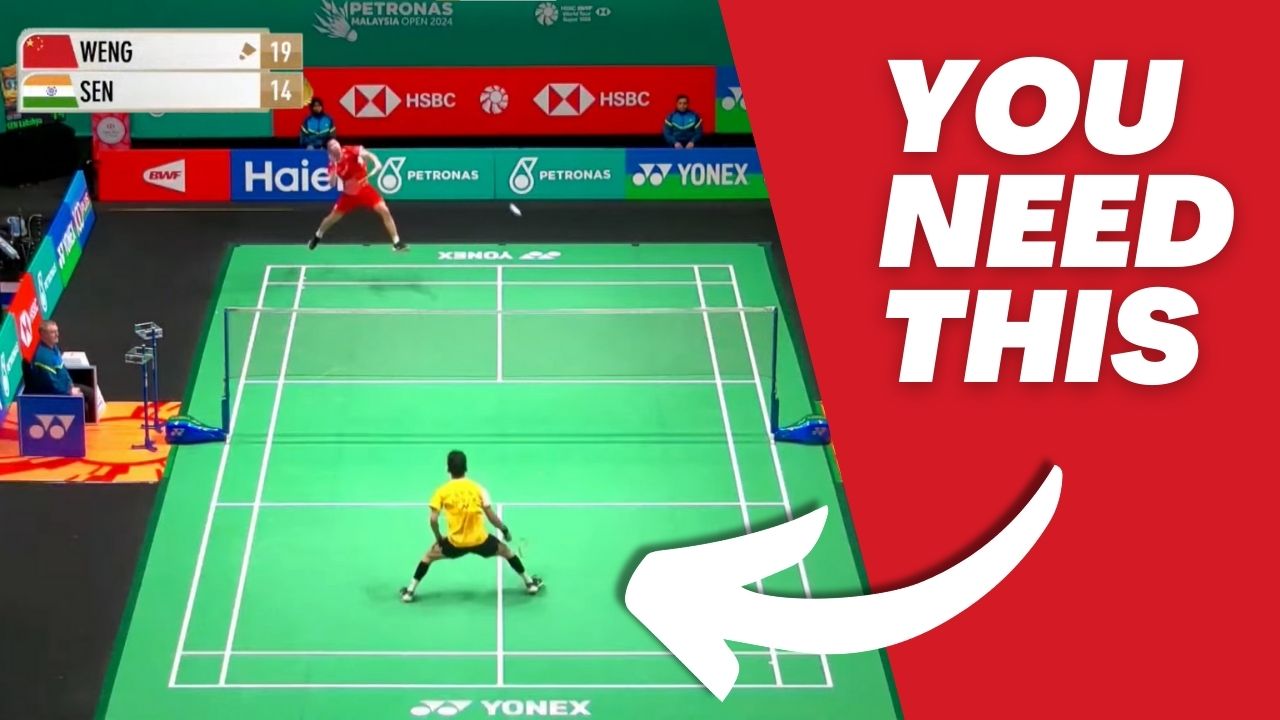
I want to bring your attention to this rally. Pay attention to the shot Lakshya plays here and notice what he covers.
You can see immediately after he hits the backhand straight, he covers the straight. Notice his left foot is almost in the center of this halfcourt.
This is mainly for two reasons.
Number one, Lakshya Sen is covering the fastest shot. In this case, the fastest shot would be a straight smash down the line. This is because it has the least distance to travel.
Number two, it is difficult to turn on for backhand defense. If Weng Hong Yang smashes straight down the line here, and Lakshya stands in the middle, he must bring his right foot over and turn his hips. This will make it much harder for Lakshya to defend as the hip turn is one of the most difficult movements in badminton.
Generally, the most dangerous shot can be categorized by two features. One being the fastest shot. In most scenarios, the fastest shot tends to be the straight smash. Another category to think about is what is the most difficult corner to move towards in this short amount of time. These tend to be the corners where the player must turn their hips and body.
–
Now, if we skip ahead a few frames you can see Lakshya doing his split step here. Notice his timing. He lands right after the Chinese shuttler has hit the shuttle. This will ensure he can move in the right direction.
Here, in this frame you can see Lakshya reacting and pushing off his left leg.
This is another reason why his defense is so good. The reaction time is insane from Lakshya Sen.
One more thing that goes into this clip is what shot Lakshya Sen is mentally prepared for. Earlier in this video we mentioned that Lakshya Sen’s body position is ready for the straight smash, but he is also mentally ready for the cross court.
This is because he notices Weng Hong Yang’s body position. From this angle, it is harder for the Chinese shuttler to hit straight as he needs to rotate, and it is more natural for him to hit the cross.
That is why he reacts so quickly. He is mentally prepared for the cross, because he knows that this is the most likely shot to come due to Weng’s body position.
It is very natural for players to hit the cross on their around the head corner, because their body is already facing that way.
Look how the shuttle hasn’t crossed the net yet, and he is already reacting.
Easy to say now, but much harder to do in game, especially after doing a full 360 on a backhand clear.
Here he pushes off his left leg and immediately makes the split second decision to dive, as the shuttle is out of his reach.
Notice his center of gravity here, extremely low to gain more power from pushing off.
His right knee hits the ground first and then the arms to help him recover.
And, he gets up smoothly in one motion.
–
Now, this is all very difficult and must be practiced, but a way to immediately make your defense better is to focus on the shot quality before.
Many times it is easy to think you have bad defense, when in fact, it’s probably your shot quality before that makes it so difficult to defend.
A halfcourt lift is much easier to kill than a full court one.
If we go back to this clip, we can see that Lakshya Sen has enough time to turn around and prepare his split step because his clear is higher.
We also want to take a look at Weng Hong Yang’s feet position. If we look at where he is hitting, notice that his feet are all the way in the back between these two lines. This will make it so the shuttle has to travel a much farther distance, therefore giving more time to react.
—
If you want to start defending like Lakshya Sen, Lee Chong Wei, Lin Dan or other pro players, you want to start by understanding which shot is most dangerous. Understanding which shot is most dangerous starts by either watching more pro play, or playing more sparring matches in general and noticing when you get killed versus when you can defend well. Don’t be afraid to experiment when playing practice matches.
Second, is the reaction time. While you definitely can train your reaction time, it is more reliant on your focus during the rallies.
Probably the most important of them all is your shot quality before your defense. A lot of times we are mistaken and think we have bad defense, when in reality our lift or clear was terrible quality.
Focus on these three aspects and you will definitely find your defense improving!
–
If you guys liked this video, make sure to hit the like button and subscribe to not miss out on any new content!
Thanks for watching, and let us know what we should do next in the comment section below!
Your game, in data
Stop guessing what to work on
GGAB turns your own match footage into rally-by-rally data: shot mix, error patterns, where points are won and lost. See the patterns this article describes in your own game, with evidence.