
[transcript]
Whether you’re a men’s or women’s singles badminton player, moving faster and more smoothly on the court is something we all desire and need. That’s why all top badminton players have spent a good chunk of time shadowing and practicing their footwork.
But why does it sometimes feel like your footwork is not improving even though you’re shadowing hours on end every day? Well, it could be that certain movements you’re practicing on your own are inefficient and don’t translate well into real games.
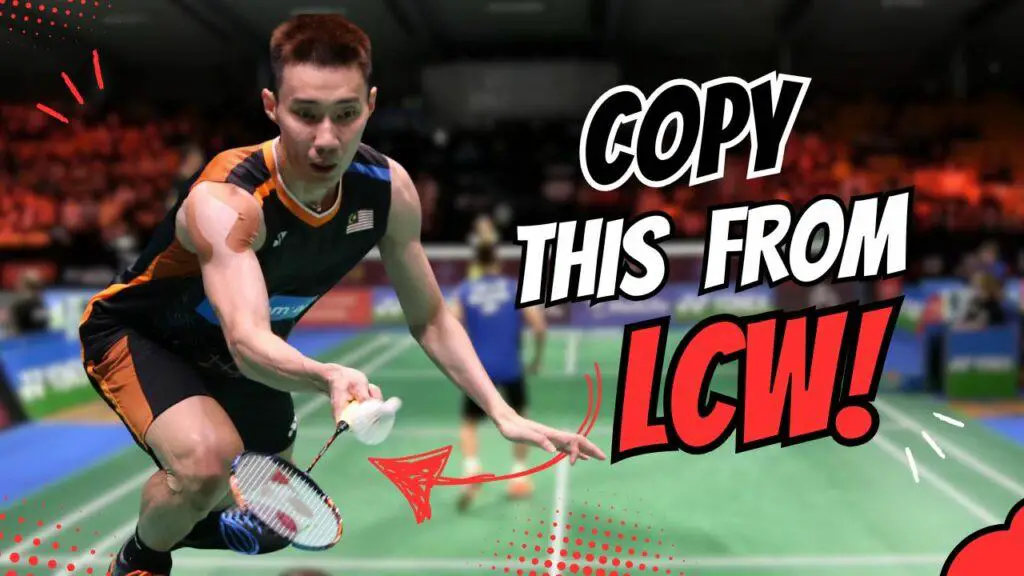
If you want to get better footwork, then there’s arguably no better person to analyze than Lee Chong Wei. Today, we’re going to take a look at a couple must-know badminton secrets to move faster in singles by studying Lee Chong Wei’s footwork.
–
So you know how to split step, you know how to shuffle, you know how to crossover, and you’ve been training plyometrics, weights, and running for hours every week.
Yet, for some reason, you just can’t seem to move smoothly to various corners and always take the shuttle late.
One reason that could be affecting your ability to move is how your feet are positioned and to understand this, we first need to talk about how you move on court.
Most of you are familiar with the split step. Most of you will also understand that to move in one direction, you have to push in the opposite direction.
This seemingly obvious concept is something people understand but don’t implement well enough.
Let’s look at Lee Chong Wei’s two different movements to his around the head.
The reason Lee Chong Wei moves more smoothly in the second clip is because his right foot is in front and angled.
This position is the best for moving to your around the head because it gives you the most surface area for maximum force exertion.
To move smoother and faster on court, you need to combine this idea with shot selection and anticipation. The reason why Lee Chong Wei is so smooth is because he positions himself for the most likely and dangerous shot based on the shot he plays.
Look at how he changes his foot positioning in these rallies to prepare for his around the head.
You can see there’s a goal in mind. By putting your feet in this position, you’re basically preparing to change speed to your around the head and opting to neutralize other shots.
These foot adjustments can be applied to all other situations, too. Place your feet where you have the most surface area to push off from in anticipation of the most likely or dangerous shot.
Let’s look at defense, for example. After Lee Chong Wei plays a clear or lift, he will often go to a position where his feet are side by side with his toes facing forward.
This is because the smashes are the most dangerous shots, and he needs to have the best ability to push from side to side.
With the same concept in mind, Lee Chong Wei often moves his right foot forward after playing a good block so he can move to front or back faster.
Just think of how many options your opponents have when they take your block under the tape. All they can really do is push or net, which means there’s really no reason to prepare for midcourt shots.
Here’s another example. If you think your opponent is going to push to your forehand side, sometimes it’s worth preemptively switching your dominant foot back so that you can instantly jump out and attack the push.
In the case that your opponent does net back, it’s not the worst either, as it’s relatively easy to push off your right leg and either re-net or push your opponent.
However, I will mention that brushes are a little bit of different story. If you want to change pace at the net, you generally will be better off keeping your dominant leg forward because that’s the easiest position for you to jump at the net and keep your balance.
–
Another reason why you may feel like your footwork is not smooth is because of your recovery. It doesn’t matter how fast or strong you are if you always move at the wrong time.
Part of the reason Lee Chong Wei looks so smooth on court is because his rhythm is rarely broken and this is because his recovery is tied to the shot he plays.
Let’s take a look at Lee Chong Wei’s full smash.
Notice how Lee Chong Wei immediately pushes off and runs forward to the net. The reason is because his smash is very fast and the most likely shot is a block that’ll be coming back pretty much instantly. There is no time for him to shuffle to the middle and then split.
Let’s take a look at Lee Chong Wei’s footwork after playing a clear now.
Here, Lee Chong Wei shuffles forward to the middle. This is because he needs to respect that the opponent has more shot choices from their position.
You’ll also notice that Lee Chong Wei sometimes chooses to walk as well if he plays a very high clear or lift. There is more time to recover when you do this and you don’t necessarily need to be consuming so much energy by staying low.
You can also see Lee Chong Wei’s recovery speed adjustments when he drops.
I would like to note here that Lee Chong Wei doesn’t just change his recovery speed but also his positioning. If you play a very good drop, there’s a good chance your opponent may lift again.
Thus, you can see that Lee Chong Wei sometimes opts to keep his right foot back and glide forward to be ready to push to the back again.
Now, I do want to mention that even though Lee Chong Wei adjusts his recovery speed based on his shots, he almost always instantly pushes off as he plays his shot.
Pushing off instantly is key to playing at a faster speed. If you wait after hitting your shot and then recover, you’ll often mistime your recovery and end up playing a game of catch-up that you’ll most likely lose.
–
For the final part of this video, we want to talk about a concept we like to refer to as “loading the legs.”
This is really just staying on your toes, but you need to understand why doing this helps you move faster.
We like to think of our leg muscles like they’re springs. When you get on your toes, you’re contracting your muscles like when you push a spring in. Then when you drop your heels, you’re releasing the energy like you’re letting go of a spring.
One reason Lee Chong Wei is so fast on court is because he’s almost always on his toes. This allows him to split step without delay and immediately push off.
If we use the spring analogy, Lee Chong Wei essentially already has the spring pushed in and can instantly release.
It makes his split step super efficient and precise compared to those who take big hops.
–
Hopefully, you learned something from this video that you can use to get better footwork. Definitely keep these things in mind every time you train to build it into your muscle memory.
Do you think Lee Chong Wei had the best men’s singles footwork of all time? Let us know in the comment section below.
If you liked this video, don’t forget to hit the like and subscribe button so you don’t miss out. Stay tuned for our future videos!
A very interesting article using a method that I have not seen before. Your article breaks down Lee Chong Wei’s footwork into clear, tactical secrets. Normally, what I would find is the “move faster” advice.
Thank you very much for the level of detail that you went through. I read the part that focuses on the split step several times. I kept reading it to see how it is really treated as the foundation for every movement. For example, the strategy of keeping the racket foot back during defensive lunges, this is really some specific and technical insight that can change a player’s game.
When practicing these patterns in shadow footwork drills, what is a good way to self-check for maintaining that low, wide base you emphasize throughout the rally?
We played badminton as kids and my mother belonged to a league. But I haven’t seen any mention of this game for years and it is good to know that it is still being played and is still quite popular.
You have given some wonderful tips here, like staying grounded on your feet and ready to take off, as well as keeping your dominant leg forward at all times. Walking is also a great way to conserve your energy and unlike squash, you don’t need to be running all the time.
Effective badminton footwork is not about doing more drills but about moving with purpose and timing, as shown by Lee Chong Wei. His smooth movement comes from smart foot positioning, immediate recovery after shots, and staying on his toes to stay ready. By anticipating the most likely return and preparing for it early, players can move faster with less effort and make their footwork feel more natural in real games.
Hello,
I must admit I was never all that graceful on the badmitten court even in my younger days, badmitten was not all that popular here in the USA other than as a picnic event.
You have shared a good point that I would never considered myself, the position of our feet for moving quicker and more graceful on the badmitten court.
Lee Chong is a very good example what is possible if you apply yourself, I was wondering do you think we need to have some natural talent or can anyone with practice and determination be as good as Lee Chong?
Jeff
This is one of the best badminton footwork breakdowns I’ve seen online. The frame-by-frame analysis of Lee Chong Wei’s split step, especially how his jump is reactive and timed to the opponent’s contact point, is an incredibly valuable insight that’s often missed. It perfectly highlights that elite speed isn’t just about raw power, but about anticipation and efficiency. The “crossover chasse” drill at the end is a fantastic, practical way to train that explosive first step. Incredibly well-explained and useful for any serious singles player. Thank you!