When we talk about badminton legends, one name that often comes to mind is Lee Chong Wei.
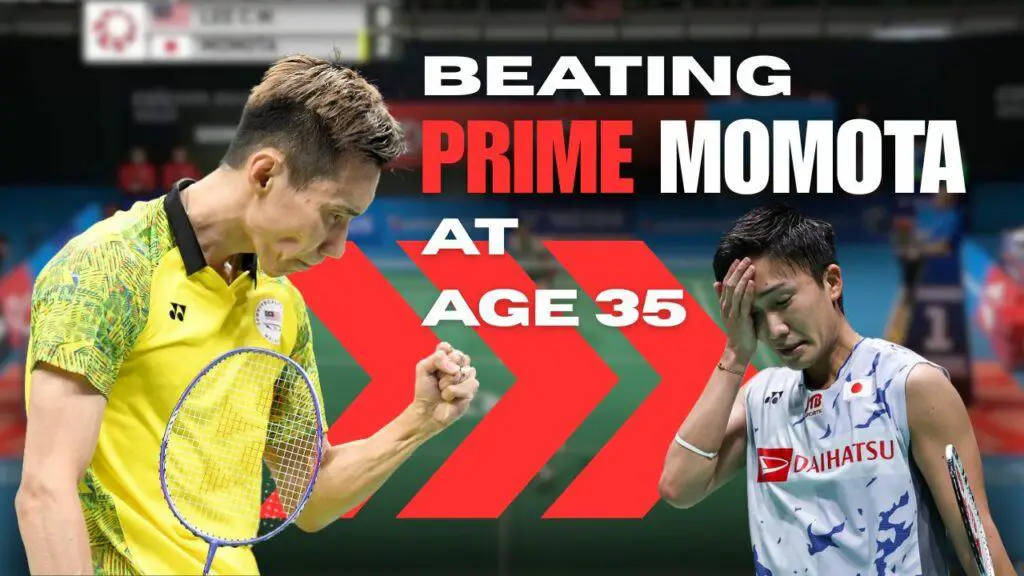
In 2018, 35-year-old Lee Chong Wei played an insane match where he won against prime Kento Momota in the Malaysia Open finals.
He played phenomenally, with a distinct strategy that broke down Momota’s game. Today, we’re going to study that strategy and share some things that Lee Chong Wei did that we can do in our own games.
–
Lee Chong Wei’s strategy against Kento Momota was simple at its core, but how he executed it was incredible.
The core of the strategy was to target Momota’s backhand. But as you all may know, simply hitting to your opponent’s backhand, especially if that opponent is Momota, is not going to work.
You need to play shots in combos that eventually force your opponent to use his backhand and continue pressuring until you win off mistakes or kills.
In the first seven rallies, Lee Chong Wei was pretty obviously playing to Momota’s backhand.
At 4 to 3, however, Lee Chong Wei sees that Momota was playing a lot of winners from his around the head straight smash. Simply playing to Momota’s backhand side was not enough which is why Lee Chong Wei begins to play a lot more straight pushes from his forehand side and cross blocks from his backhand side.
The idea is to open up the court more and move Momota to his forehand side first so that a push or slice to the backhand becomes more effective.
One thing that we would like to point out here is the small hold that Lee Chong Wei does before playing his pushes. It makes Momota’s movements more unstable as he needs to wait for Lee Chong Wei to hit before moving.
Lee Chong Wei expertly combines these holds with also hitting the shot instantly to throw off Momota’s rhythm and make it extremely difficult to play.
At this point, however, Momota has started reading Lee Chong Wei’s shots and strategies. You can see how he’s become more focused on the push timing and ready to jump out and attack.
Thus, Lee Chong Wei needs to keep Momota guessing. You may have noticed that Lee Chong Wei has not yet played any straight drops from his forehand side. So far, only cross slices, smashes, clears and drives have been played.
Even if it’s instinctively, Momota has moved closer to his backhand and further back in anticipation of these shots. And that’s how Lee Chong Wei begins punishing Momota with a straight, forehand reverse slice.
Now I do want to mention that Momota made adjustments of his own. You’ll see that Momota opts to block middle a lot more and generally further to anticipate the backcourt and attack.
You’ll also notice that Momota goes for a lot of repushes to the same side. The idea is to catch Lee Chong Wei on his recovery and then attack the likely slower shot that comes back.
These adjustments weren’t enough, though, as Lee Chong Wei ultimately takes the first game and builds a sizable lead in the second.
At around 13 to 6 in the second game, however, Lee Chong Wei does lose his focus a little bit. His pace slows down quite a bit which leads to six straight points for Momota.
This highlights just how strong of an opponent Momota was. Losing just a little bit of focus is enough for Momota to begin coming back.
That being said, Lee Chong Wei does regain his focus and adds one more thing to his strategy – lobs and tight blocks.
These shots were very effective at this stage in the match because Momota had already gotten used to playing behind the service line against faster-paced shots.
Just the little bit of extra distance that Momota has to move to will often force Momota to play a lift or make a mistake trying to play a net.
And it’s super important that Lee Chong Wei chooses this stage of the match to play more of these shots.
A lob is a super risky shot. Lee Chong Wei could easily make a mistake on this shot which is why he’s playing it after many rallies have passed when he’s more comfortable with the playing conditions.
The second thing is that Momota’s nets are a strong part of his game. Normally, these lobs would be prime opportunities for Momota to play a spin net and probably win off smashing the lift. But because he was used to playing against shots past the service line, these lobs become very difficult to deal with.
–
Lee Chong Wei did play out of his mind to beat prime Momota at 35 years old, especially considering he was diagnosed with nose cancer weeks later.
Even knowing Lee Chong Wei’s strategy was not enough. Momota was anticipating, but somehow, Lee Chong Wei would play the straight when Momota was guessing cross and play the cross when Momota was guessing straight.
Despite this, however, the score was very close.
A net roll that did not go in Lee Chong Wei’s favor could have easily turned this match into a three-set game where Momota probably had a higher chance of winning due to stronger physical at the time.
Since the match was so close, there is one small thing we believe Momota could have done to drastically increase the chances of him winning.
That thing is to play a cross shot on Lee Chong Wei’s cross more often.
One reason Lee Chong Wei was able to win this match was because Momota’s shots were relatively predictable. After playing a straight shot, be ready for the cross. After playing a cross shot, be ready for the straight.
I know it sounds a little counterintuitive to some for trying to play a cross on a cross.
Normally, you want to make your opponents run more, right? If your opponent plays a cross slice or smash, it makes a lot of sense to block straight and force them to sprint across the whole court.
However, the thing is that all pro players generally know this as well. They know that if they play a cross shot, they have to prepare to run the cross to get the next shot.
When you watch Lee Chong Wei’s positioning after playing a cross shot, you’ll notice that he’s always prepared to cover the straight return.
If Momota held his racket facing straight for a half second and then last minute played a cross, Lee Chong Wei would have had to quickly change direction which is often more tiring even if it’s a shorter distance traveled.
Lee Chong Wei also would have been more likely to take the shuttle lower which makes it easier for Momota to either push him to the back from the net or attack the lifts.
We can see how it worked for Momota a few times.
The problem is that Momota only did this like three times in the whole match. If he did it a few more times, particularly in response to Lee Chong Wei’s around the head reverse cross in addition to a few more cross smashes from his backcourt, then the story might have been different as Lee Chong Wei would have needed to respect the cross shot more.
But this is all very hard to predict and even more difficult to think about when you’re playing in a tournament finals.
–
Although Lee Chong Wei’s strategy against Momota was very simple, the execution was detailed and layered.
The goal was to play to Momota’s backhand and punish loose shots that he plays from there. Simply playing to Momota’s backhand was not going to be enough.
First, Lee Chong Wei had to open up the court first and bring Momota to his forehand side. He did this by playing a lot of backhand cross blocks and clears and pushes toward Momota’s forehand.
Executing this strategy required a lot of small holds and pace changes to prevent Momota from smoothly moving and easily attacking. Lee Chong Wei did this extremely well which was why it always felt like Lee Chong Wei was in control of the rallies.
And to top things off, at certain points in the game, Lee Chong Wei adds shots like straight reverse slices and lobs to punish Momota’s overcommitment to certain shots, making Lee Chong Wei’s game unpredictable and nearly impossible for Momota to play against.
We’re not all as technically gifted or skilled like Lee Chong Wei to execute his specific strategy, but there are a few takeaways we can apply at any level.
First, start with a game plan in mind. Many players make the mistake of trying to do everything and end up making unforced errors. Having a game plan will also help make your movements smoother, as there are shots that are generally more expected based on the shot you play.
If you know what shot you’re going to play, you should also know what the likely returns are going to be and prepare yourself for those returns.
Second, if your game plan doesn’t go the way you want it to go, that’s okay. Don’t panic and switch strategies. Instead, start adding layers to it, like playing to another corner first and then playing to the corner you want to target.
And if you ultimately lose the game or match, that’s okay, too. You know that your strategy or your skills required to execute the strategy were not good enough and you have specific things you can point to that went wrong.
Which means, now you have specific things you can work on in practice to level up your game much faster compared to doing a little bit of everything.
If you liked this video, please remember to hit the like and subscribe button so you don’t miss out on our future content. Let us know what you want to see next in the comments below!